
Let visitors tell your site who they are (and why browsers should keep it)
How an “ask” box, browser-stored profiles, and conversational UI are reshaping agency workflows and what to keep human.
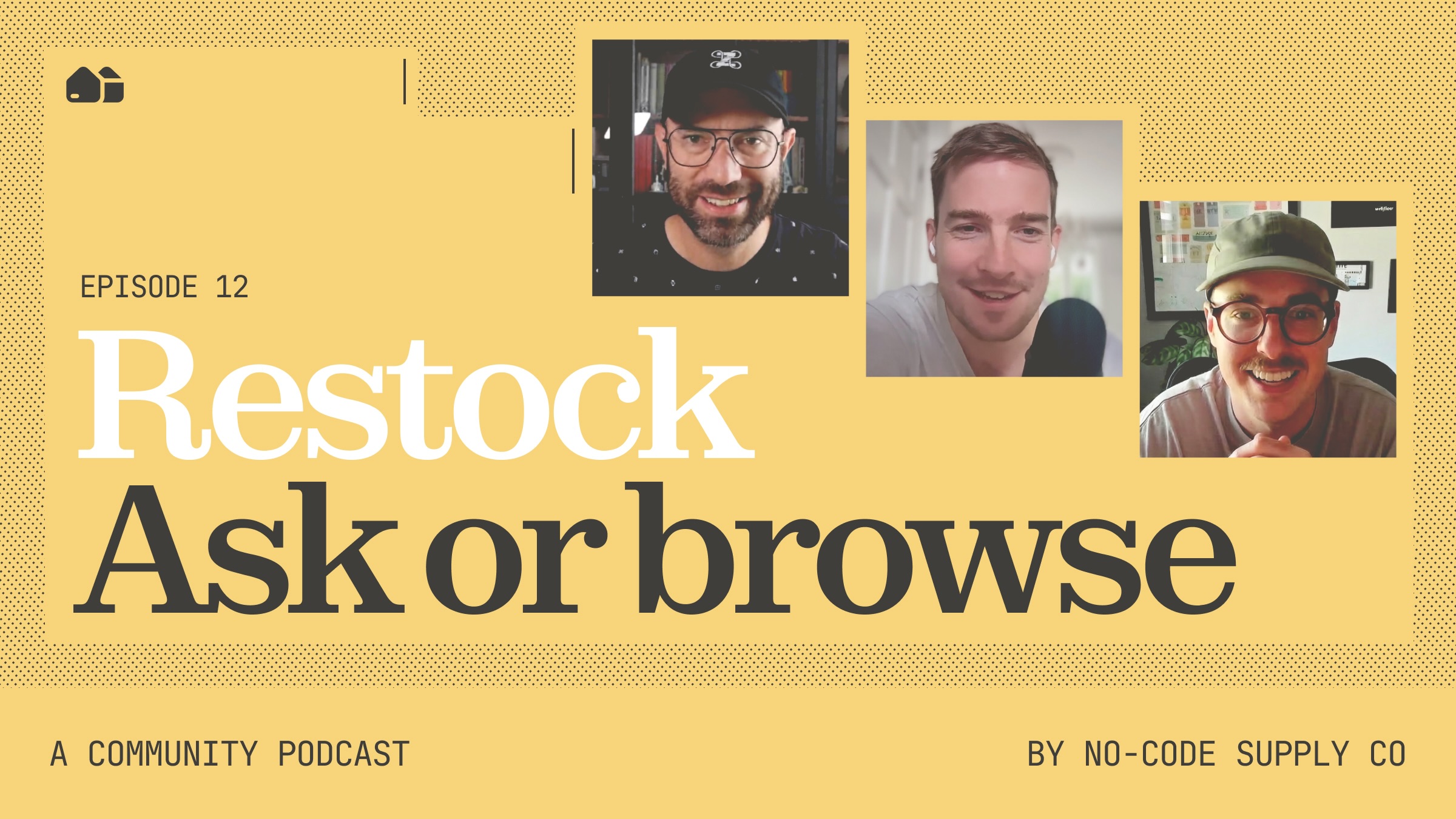
Ep. 12 | Ask or browse
with Liam McCabe cofounder of Code & Wander
“Whenever the visitor can actually declare what they're looking for, that's a lot stronger signal,” Liam McCabe said — and that line is the spine of this conversation.
Corey Moen, Liam McCabe, and Matthew spent ~53 minutes tracing the small product moves that change how sites behave: an Ask box on a page, a prompt that writes back to Slack, cached queries that expose gaps in your copy, and the idea that a browser could store a user profile (shirt size, aesthetic preferences) so every storefront you hit already knows you.
Why an explicit “ask” beats your current analytics
Analytics tell you what people clicked and how long they stayed. Ask boxes tell you why they came. Liam described Ask Kodamwonder — a prompt box on generated pages that logs queries, routes uncertain answers to Slack, and updates the knowledge base so future answers are better.
Concrete wins they’ve already seen:
missing content surfaced (people asked for co-founders that weren’t on the about page)
recurring service queries that prompt internal product conversations (e‑commerce requests leading to a “maybe we should offer this”)
clear signal separation between who clicks buttons and who writes a question
That last point matters: a typed question is a stronger intent signal than inferred behavior. It changes what you measure and lets you design follow-up journeys (comments, threaded replies, or generated pages) instead of guessing at funnels.
“It’s like you can get a sense of quality if you go into a store and touch and feel,” Corey said — and that’s why some brand experiences will resist being flattened into an immediate agent reply.
Put the profile in the browser, not scattered in cookies
They sketched a simple mental model: a browser-level profile where you opt in and store durable preferences — location, clothing sizes, role (agency founder), dark mode — that travel across sites. The benefit is obvious for commerce and services: pages preload the right size, landing pages adapt to persona, and outbound campaigns carry context without rebuilding landing pages for every audience segment.
Practical friction they flagged:
adoption will be opt-in, so most users might not opt in at first
privacy and accessibility groups once worried preferences could be used to fingerprint users
vendors will hesitate to throw away the data they already collect
Still, the group agreed that if browsers offered a safe, user-controlled API for portability of preferences, it would remove dozens of fiddly site-level toggles and improve first-time conversions.
Design systems, Source, Elix and the freedom argument
Conversation pivoted to Webflow Source, Sketch co‑founders’ Elix teaser, and the tension between “design system generation” and creative websites. The consensus: code as source of truth is back in focus — not to kill designers’ canvas work, but to make the two stay aligned.
Key specifics they discussed:
Source could mean working from an open code workspace (Astro, Next.js) while preserving visual editing for marketers
Elix (the name/extension people are debating) might be a file type that holds components; the fear is lock-in unless the files are inspectable JSON
agencies increasingly prototype in Figma to 50–60% then jump into code to test interactions and hand clients interactive sandboxes
Liam described a workflow where designers get a config panel of toggles, clients play with parameters, and an export button spits out the configuration to apply across pages — a small change that reduces back-and-forth and makes interactive sites feasible on retainer budgets.
When agents automate the admin, humans still sell the relationship
They pushed back on the headline “agents replace agencies.” Liam shared recent experiments building an SEO agent and a platform that could recommend content, hook into Webflow, and auto-implement suggestions. The tech can get frighteningly capable: sub-agents, one-shot runs, self-improving content and UX.
But Corey landed the human counterweight: trust, empathy, and strategic partnership don’t translate to a single API. The clients who stayed the longest were the ones where the agency acted like a partner solving business problems — not just a ticketing machine. Automate the tedious, keep the conversations:
more time for storytelling, strategy, and growth loops
fewer hours on spelling fixes and broken links
higher-value creative work that justifies retainers and builds relationships
They also worried, usefully, about a feedback loop where agents optimize for agents: if SEO and content recommendations are written for model consumption, who benefits — humans or the algorithms?
Tools they named (small list, big signals)
Ask Kodamwonder (Liam’s prompt box hooked to Slack and a knowledge base)
Astro (a recurring favorite for “respecting HTML/CSS/JS”)
Claude Desktop, Cursor, Codex, Framer (comparison points for agent/UIs)
The technical takeaway: build the knowledge corpus now. Whoever has the canonical content and component library will have better outputs from UI generation and agents.
To close, they circled back to one persistent refrain: own your street address. A website is the digital shop you control. Even if agents, prompts, or in-chat renders can serve immediate answers, the ritual of immersion — exploring brand, clicking through pages, feeling the craft — still drives trust.
Leave the repetitive admin to an agent; keep the human conversations that win long-term clients.
Watch Ep. 12 | Ask or browse with Liam McCabe cofounder of Code & Wander https://youtu.be/WFNqoUSVL_4